
Manual Welding Fume Extraction
Manual welding fume extraction has to travel with the welder. Between the bench, the rotator and the chassis in the next bay the plume is never in the same place twice — so the arm, the airflow and the cleaning mode have to be chosen for a moving source, not a fixed one.
20–25%
of a manual welder’s shift with the arc actually struck
0.5–1.0 m/s
capture velocity HSG258 expects at a welding arc
150–300 mm
working distance a fume arm has to hold to stay effective
The welder moves, and so does the fume
A manual welder does not stay in one place. Over a shift he might tack a frame on the bench, turn a vessel on the rotator, then climb onto a trailer chassis in the next bay — and the fume goes with him, because the arc is the source and the arc keeps moving.
Most welding bays are laid out for the job, not for the extraction. The unit ends up parked where there is floor space, the arm is asked to reach a joint two metres away, and by the third job the hood has drifted back against a wall because it was fouling the torch. Capture velocity falls off sharply with distance: a hood that holds the fume at 200 mm does very little at 600 mm, and by a metre it is decoration.
The measurements back that up. In a field study of a pipefitter doing shielded metal arc welding on carbon steel, the same welder doing the same job averaged a breathing-zone total particulate of 2.89–4.38 mg/m³ out in a breezeway but 4.73–5.90 mg/m³ inside a boiler room — and the arc was struck for only 20–25% of the sampling time. The fume concentrates wherever the air cannot leave, which is why a unit that can be rolled into the confined bay does more for exposure than a bigger fan out in the open shop.
What the measurements show
3.0–11.3 mg/m³
Breathing-zone total particulate measured within 0.5 m of manual metal arc welders in six factories, averaged over full 8-hour shifts.[1]
4 of 6 shops
Four of those six factories came out above the local exposure limit on the same study’s equivalent-exposure index — the worst at 5.1× the limit.[1]
470 µg/m³
Highest total-particulate manganese TWA measured on stick welders rebuilding refinery tanks and piping: 18 welders exceeded the ACGIH total Mn TLV of 100 µg/m³, and 25 exceeded the respirable TLV of 20 µg/m³.[2]
0.5–1.0 m/s
The capture velocity range HSG258 gives for welding fume — and the top of it is the one that applies to continuous work, small hoods, higher-toxicity fume and draughty bays, which is most manual welding.[3]
Full sources are listed under References at the end of this page.
How we solve it
The principle is the same as any source capture: get the hood to the arc before the plume rises into the breathing zone, filter it to 0.3 µm, and return the cleaned air to the shop. What changes with manual work is that the welder has to move the hood fifty times a shift without thinking about it — and a hood that is awkward does not get used, whatever the risk assessment says.
Follow the arc, not the bay
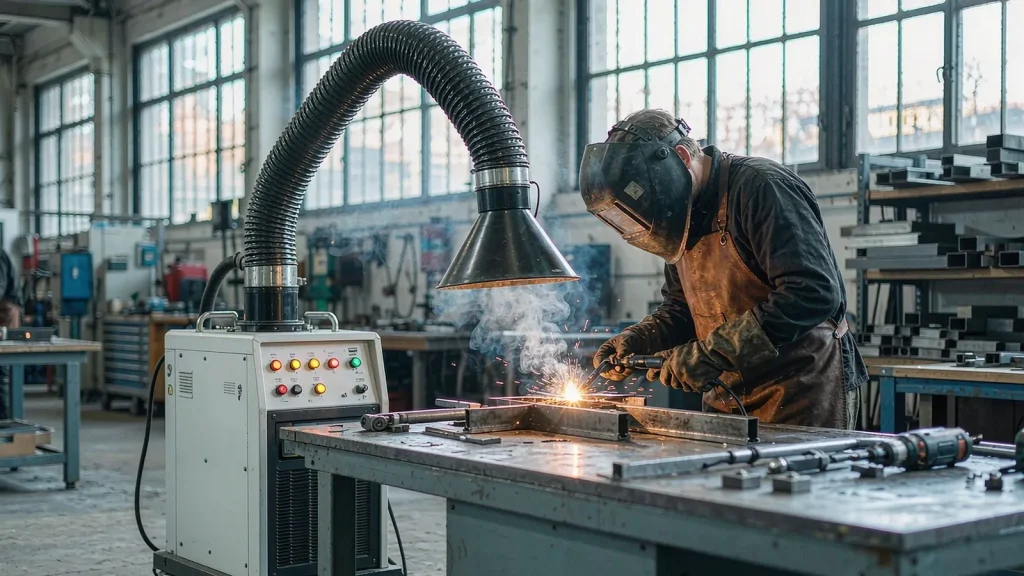
Every mobile unit in this range carries a 360° self-supporting arm — 1.5 m, 2 m or 3 m depending on reach — so the hood can be parked over a horizontal joint, swung onto a vertical run, or dropped into a corner without a second pair of hands. The smallest unit uses a φ58 × 2000 mm suction tube for bench and fabrication-table work, where even a short arm gets in the way of the job. The distance to hold is 150–300 mm from the arc; that is where a correctly sized unit still delivers the capture velocity HSG258 expects, and it is the number our commissioning report records.
Size for the arc-on hours, not the shop size
A welder’s arc is only struck for part of the shift, so a jobbing shop welding intermittently on mixed work is not the same duty as a two-man bay running production all day. For intermittent work, manual-clean units keep the price and the maintenance low and need no compressed air. For production, pulse-jet cleaning keeps the cartridge working without anyone stopping to service it: FDYD-22H, FDYD-28M (built-in 800 W compressor, so no air line to the bay), FDYD-28M2 and FDYD-38H2 cover the heavier duties, and FDYD-11Z / FDYD-15Z add PLC control with a filter-clog alarm for shops that want the state of the cartridge visible from the floor. Two adjacent bays can share one filter: FDYD-20P2 carries two independent 360° arms on a single unit.
Ten units for manual welding bays
Ten units cover a single bench through to two-station and high-duty production welding. Every model filters to 0.3 µm and returns clean air to the workshop, so nothing has to be ducted through a wall.
What arrives on the pallet
- 360° self-supporting extraction arms in 1.5 m, 2 m and 3 m reach — the welder parks the hood over the joint and it stays there, including on vertical and overhead work
- A φ58 × 2000 mm suction tube for the smallest units, for bench and fabrication-table welding where an arm would foul the job
- Replacement cartridge sets, a first-stage pre-filter to take the coarse spatter-borne dust before it reaches the main cartridge, and spare castors
- Commissioning with capture velocity measured at the arc working distance rather than at the hood face, plus a filter-change schedule written around your arc-on hours
Arm reach, cartridge grade and cleaning mode are fixed at order. Drawings showing arm positions and reach circles for each bay are issued with the quotation, so you can check the coverage before anything is built.
Manual welding jobs it fits
Manual welding bays in fabrication and structural steelwork, agricultural and plant machinery repair, trailer and chassis building, tank, vessel and pipework fabrication, maintenance and fitting shops, boatyards and rail depots, and welding training centres. Processes covered: MMA (stick), MIG/MAG, TIG, flux-cored arc and light gouging. Stainless, galvanised and painted steel raise the hazard rather than just the odour — those jobs need the hood at the arc. Confined work in tanks, vessels and holds needs the exposure measured, not assumed. If the fume source is a fixed machine rather than a moving torch, the laser cutting, plasma cutting and grinding pages are the better starting point.
In the bay
Questions from welding shops
Send us your welding positions
Tell us how many welding positions you run, which processes (MMA, MIG/MAG, TIG, flux-cored), what materials, and the arc-on hours per shift. We will size the arms, airflow and cleaning mode, and send a selection drawing with arm positions and reach marked for each bay.
References
- Balkhyour MA, Goknil MK. Total fume and metal concentrations during welding in selected factories in Jeddah, Saudi Arabia. Int J Environ Res Public Health 2010;7(7):2978–2987. doi:10.3390/ijerph7072978 ncbi.nlm.nih.gov — 8-hour breathing-zone sampling within 0.5 m of manual metal arc welders in six factories.
- Andrews RN, Ashley KE, Bertke S, Hanley KW. Manganese fractionation using a sequential extraction method to evaluate welders’ shielded metal arc welding exposures during construction projects in oil refineries. J Occup Environ Hyg 2015;12(11). NIOSH. stacks.cdc.gov
- Health and Safety Executive (UK). Controlling airborne contaminants at work: a guide to local exhaust ventilation. HSG258, 3rd ed. — Table 9, recommended capture velocities for welding fume, and the commissioning checks for a moveable extraction arm. hse.gov.uk
- Boelter FW, Simmons CE, Berman L, Scheff P. Two-zone model application to breathing zone and area welding fume concentration data. J Occup Environ Hyg 2009. doi:10.1080/15459620902809895 pubmed.ncbi.nlm.nih.gov — one welder, SMAW on carbon steel, breezeway versus boiler room.
- IARC Working Group. Welding, molybdenum trioxide, and indium tin oxide. IARC Monographs on the Evaluation of Carcinogenic Risks to Humans, Volume 118, 2018. Summary: Guha N, et al. The Lancet Oncology 2017;18(5):581–582. doi:10.1016/S1470-2045(17)30255-3
- Health and Safety Executive (UK). Change in enforcement expectations for mild steel welding fume. Safety alert STSU1-2019. hse.gov.uk