
Pharmaceutical Powder Dust Extraction
Pharmaceutical powder dust extraction carries two requirements that do not always point the same way: the powder has to be contained, because it is potent and the product is valuable, and the collector has to be protected, because sugar, flour, starch and many excipients are combustible dusts with a long incident record.
24%
share of US dust explosion incidents attributed to food products
14 deaths
one sugar refinery explosion, caused by accumulated sugar dust
1/32 in
dust layer over 5% of a floor area that is treated as hazardous
Two hazards in the same powder
A powder that is safe on a shelf becomes a hazard the moment it is dispersed in air — and the operations that disperse it are exactly the operations that manufacture the product.
In pharmaceutical production the first concern is usually containment: potent actives have occupational exposure limits measured in micrograms, and cross-contamination between products is both a quality and a safety issue. In food production the concern is often explosion: flour, sugar, starch and spray-dried powders all form explosive clouds, and the sector has a disproportionate share of the recorded incidents.
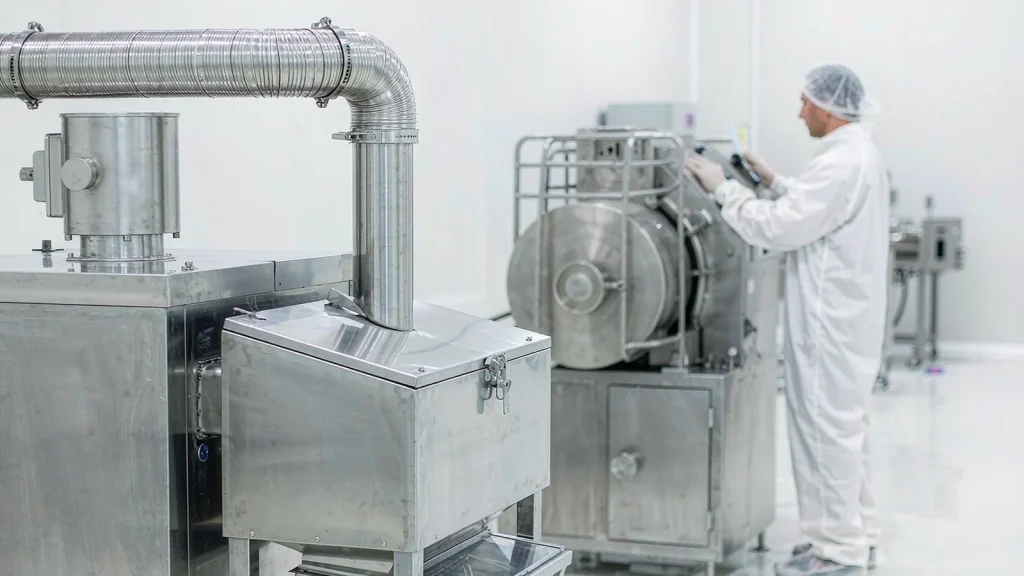
Both requirements are met by the same equipment decision — a collector that is sealed, vented and discharged without opening the powder to the room, with the ducting and the capture point designed so the operator never works in the cloud. The differences come in the detail: the filtration class and the change procedure for a potent active, the Kst and venting arrangement for a sugar, and the material of construction for a hygroscopic or corrosive powder.
What the incident record shows
24%
Food products were the single largest industry category in the US Chemical Safety Board’s study of 281 dust explosion incidents over 25 years — ahead of wood processing at 15%. These materials are not widely treated as hazardous by the people handling them.[1]
14 deaths
The Imperial Sugar refinery explosion in 2008 was caused by accumulated sugar dust. The CSB investigation found inadequate housekeeping, equipment design and maintenance, and went on to identify the same pattern in earlier sugar industry incidents.[2]
1/32 in
A dust layer this thin covering 5% or more of a floor area is treated as hazardous. A primary event inside a collector or a duct can lift it and create a much larger secondary explosion.[1]
1,400–3,600 m³/h
Air volume across the units in this range for powder handling duty, from FDFB-17P at a single weighing or sieving station to FDFB-H6-25C on a larger process, all with explosion venting and antistatic media.[3]
Full sources are listed under References at the end of this page.
Contain it first, then protect the collector
Containment and explosion protection are usually designed as one system, because the same enclosure that holds the dust in is the enclosure that has to survive an event inside it. The capture point comes first, then the collector, then the discharge.
Capture the operation, not the room
The dust-generating steps are known in both industries: weighing and dispensing, milling, blending, granulating, drying, sieving and packing in pharmaceutical work; flour, sugar and starch handling, spray drying and packing in food. Each gets local capture sized to the operation — FDFB-17P (1,400–1,700 m³/h) at a weighing or sieving station, FDFB-34P (2,900–3,200 m³/h) where the station is larger or two are grouped, FDFB-H2-25C (2,200–2,500 m³/h, 60 m² media) where the material is classified and a higher filtration area is wanted, and FDFB-H6-25C (3,600 m³/h, 120 m²) for multi-station duty on one collector.
Design the collector around the dust data
The protection concept depends on values that only testing provides: Kst and Pmax for the venting sizing, minimum ignition energy and temperature for the earthing and the temperature limits, and the occupational exposure limit of the active for the filtration class and the safe-change procedure. On a potent compound that usually means a sealed cartridge change-out rather than an open one, and a documented cleaning procedure between products. On a combustible powder it means venting, isolation and a discharge that keeps the collected dust out of the room air. Where a material has not been tested, the test is part of the project.
Explosion-protected units for powder handling
Four units cover powder handling stations from a single weighing bench to a multi-station process, all built for combustible dust with venting and antistatic media.
What a powder handling installation includes
- Local capture at the dust-generating step — weighing, milling, blending, sieving, drying or packing — with the hood arranged so the operator is outside the cloud
- An explosion-protected collector with venting, antistatic media and bonded conductive ducting, sized from the Kst and Pmax of your powder
- Sealed or contained discharge: rotary valve or sealed bin, with a cartridge change-out procedure written for the material
- Commissioning with earth-continuity and bonding checks, airflow at each capture point, and a documented cleaning and change sequence
Send the powder data you hold — Kst, Pmax, minimum ignition energy, occupational exposure limit — and the process steps. On this page more than any other, the specification follows from your test data rather than from a catalogue number.
Processes and materials this covers
Tablet and capsule production, API handling and dispensing, milling, blending, granulating, drying, sieving, weighing and packing in pharmaceutical manufacture; flour, sugar, corn flour, starch, cocoa and spray-dried powder handling, mixing, sieving and packing in food production; and the same operations in nutraceutical, cosmetic powder and speciality chemical plants. Materials include potent actives, excipients, lactose, cellulose, sugars, starches, flours and spray-dried powders. Where the material is a metal or a carbon powder rather than an organic powder, the battery and aluminium pages describe the different protection requirements.
At the station
Questions from pharmaceutical and food producers
Send us the powder data and the process steps
Send the process steps, the powder data you hold, the occupational exposure limit of any active, and how the area is cleaned between products. We will come back with the capture arrangement, the protection concept and the containment provisions — and tell you plainly which parts depend on tests you still need to have done.
References
- Dust explosions. ACS Chemical Health & Safety 2008;15(3):32. — US Chemical Safety Board data on 281 dust explosion incidents over 25 years, the distribution of incidents by industry (food products 24%), and the hazardous dust layer criterion. pubs.acs.org
- U.S. Chemical Safety Board. Final report: Imperial Sugar refinery dust explosions, Port Wentworth, Georgia, 2008. csb.gov
- NFPA 61 Standard for the prevention of fires and dust explosions in agricultural and food processing facilities, and NFPA 652/660 for combustible dust fundamentals — the standards a food or pharmaceutical powder installation is normally assessed against.
- Health and Safety Executive (UK). Dangerous Substances and Explosive Atmospheres Regulations 2002 (DSEAR), approved code of practice — duties covering explosive atmospheres and combustible dusts in the UK.
- Health and Safety Executive (UK). Controlling airborne contaminants at work: a guide to local exhaust ventilation. HSG258, 3rd ed. — Table 9 capture velocities for welding fume, and the commissioning checks for a moveable extraction arm. hse.gov.uk