
Aluminium Dust Extraction for Polishing and Grinding
Aluminium dust extraction is the point where respiratory protection stops being the whole answer. Polishing and grinding aluminium and magnesium produce a fine, reactive metal dust that is not only an inhalation hazard but an explosion hazard, and the extraction system becomes part of the protection concept rather than an add-on to it.
200–315 bar·m/s
Kst of aluminium powder — severity class St 2 to St 3
≤ 200 / 200–300 / > 300
the St 1 / St 2 / St 3 severity bands in bar·m/s
1,000–3,200 m³/h
air volume across the explosion-protected units for single and twin polishing stations
The most dangerous dust in the shop comes off the polishing wheel
A polishing shop smells of compound and looks harmless. The dust coming off the wheel is one of the more reactive materials in any factory, and it does not need a flame to light it — a static discharge or a hot particle from the wheel will do it.
Aluminium and magnesium are reactive metals, and in fine powder form they burn fast. The dust from polishing and grinding wheels is a mixture: metal from the workpiece, abrasive from the wheel, and polishing compound or dust from the coating. That mixture is generally finer and more reactive than the metal alone, and it accumulates in a collector — which is the enclosure where a cloud is most likely to exist.
The values that decide the design are measured, not assumed. Kst places the dust in a severity class, Pmax sets the venting, and the minimum ignition energy and temperature determine whether earthing, bonding, surface temperature limits and non-sparking components are enough or whether the material demands a different collection principle altogether. Magnesium, in particular, is treated as a separate case from aluminium in most guidance.
Why aluminium and magnesium are treated differently
200–315 bar·m/s
Explosion severity (Kst) of aluminium powder, which places it in St 2 to St 3 — the upper end of the severity classification. Reactive metals sit above most organic dusts in this table.[1]
≤200 / 200–300 / >300
The St 1, St 2 and St 3 severity bands in bar·m/s. Aluminium at 200–315 crosses two of them, which is why the protection concept is not a catalogue choice but a design against the material.[2]
1/32 in
A layer this thin over 5% or more of a floor area is treated as hazardous. In a polishing shop that layer is the by-product of a week’s work, and it is the fuel for a secondary explosion after a small primary event.[3]
FDFB series
The units for this duty are built differently from general-purpose collectors: metal housings, antistatic filter media, integrated explosion venting, spark and hot-particle arrestors ahead of the media, and conductive ducting and components, all bonded to earth.[4]
Full sources are listed under References at the end of this page.
Capture at the wheel, then make the collector safe
An aluminium dust installation has two halves that must be designed together: capture at the point of generation, so the dust does not become airborne in the shop, and a collector that can survive and contain an ignition inside itself.
Capture at the wheel, at the right velocity
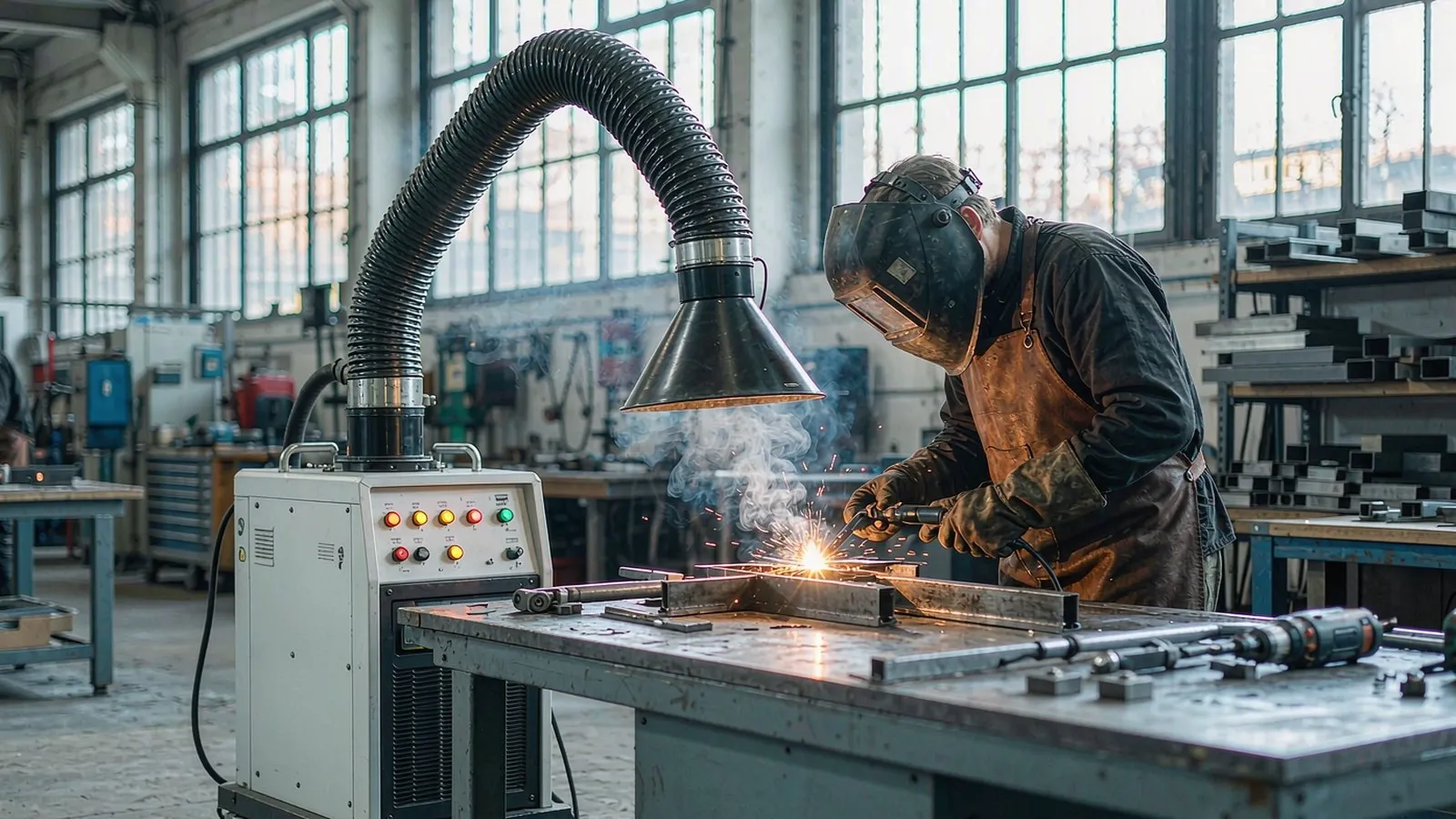
Polishing and grinding throw dust outward and downward from the wheel, so capture is at the wheel face or immediately behind the work, not above the bench. FDFB-10P (1,000 m³/h) and FDFB-15P (1,500 m³/h) cover a single station with a light loading, FDFB-20P and FDFB-21P (1,500–2,100 m³/h) the larger single station, and FDFB-34P (2,900–3,200 m³/h, 44 m² media) two stations or a heavier operation. Every one of them is a sealed unit with the media protected by a spark and hot-particle arrestor — on this duty the arrestor is not an option.
Make the collector part of the protection concept
The protection chain runs from the wheel to the discharge. Earthing and bonding across ducting, hose and unit; antistatic filter media so the cartridge does not accumulate charge; explosion venting sized from the material’s Kst and Pmax, or flameless venting where the unit has to sit inside a building; isolation so an event cannot travel back up the duct; and a discharge that keeps the collected powder out of the room air. FBFB-BF65 is the powder dosing unit used where inerting is part of the strategy. Where the material is magnesium, or where the dust is very fine and the minimum ignition energy is low, the collection principle itself may need to change — that is a conversation to have before the unit is ordered, not after.
Explosion-protected units for Al and Mg work
Six units cover single and twin polishing stations and heavier finishing duty on aluminium and magnesium, all with explosion venting and antistatic media.
What an aluminium or magnesium installation includes
- Capture at the contact point — hood or plenum at the wheel face, arranged so the dust is taken as it leaves the wheel rather than after it has passed the operator
- An explosion-protected collector with venting sized from your dust data, antistatic media and a spark and hot-particle arrestor ahead of the cartridge
- Bonded, conductive ducting and components, with the earth-continuity checks documented at commissioning
- Discharge arranged to keep collected powder out of the room air, plus a housekeeping plan for the dust layer that accumulates on surfaces
Send the material (aluminium, magnesium, alloy and which one), the operation, the wheel or belt used and the dust data you hold. On reactive metal dust the design follows the test values, and where none exist the test is the first deliverable of the project.
Materials and operations this covers
Aluminium wheel and casting polishing, aluminium extrusion and profile finishing, aerospace panel finishing and surface preparation, magnesium component manufacture and finishing, boatyard and marine aluminium work, and general metal polishing shops handling aluminium, magnesium and their alloys. Operations include belt grinding, linishing, polishing with compound, deburring and dressing. Where the same shop also grinds steel or stainless, those operations can share extraction but not necessarily the same protection concept, because the dust characteristics differ.
At the wheel
Questions from polishing and finishing shops
Send us the material, the wheel and the dust data
Send us the material and alloy, the operation, the wheel or belt specification, the dust volumes per shift and any test data you hold. We will come back with the capture arrangement, the protection concept and the points that depend on testing — and say so where that is the honest answer.
References
- Combustible dust risks in battery and metal powder handling — Kst values and severity classes for aluminium powder and related materials. Manufacturer technical guide. robovent.com
- Explosion characteristics of aluminium and aluminium alloy powders. Journal of the Southern African Institute of Mining and Metallurgy 2012;112(7):563. — Kst, Pmax and ignition characteristics of aluminium dusts and the St 1/2/3 classification bands.
- Dust explosions. ACS Chemical Health & Safety 2008;15(3):32. — hazardous dust layer criterion and the mechanism of secondary explosions. pubs.acs.org
- NFPA 652/660 on combustible dust fundamentals, and NFPA 484 for combustible metals — the standards covering explosion protection, venting, isolation and the specific treatment of aluminium and magnesium dusts.