
Grinding Dust Extraction
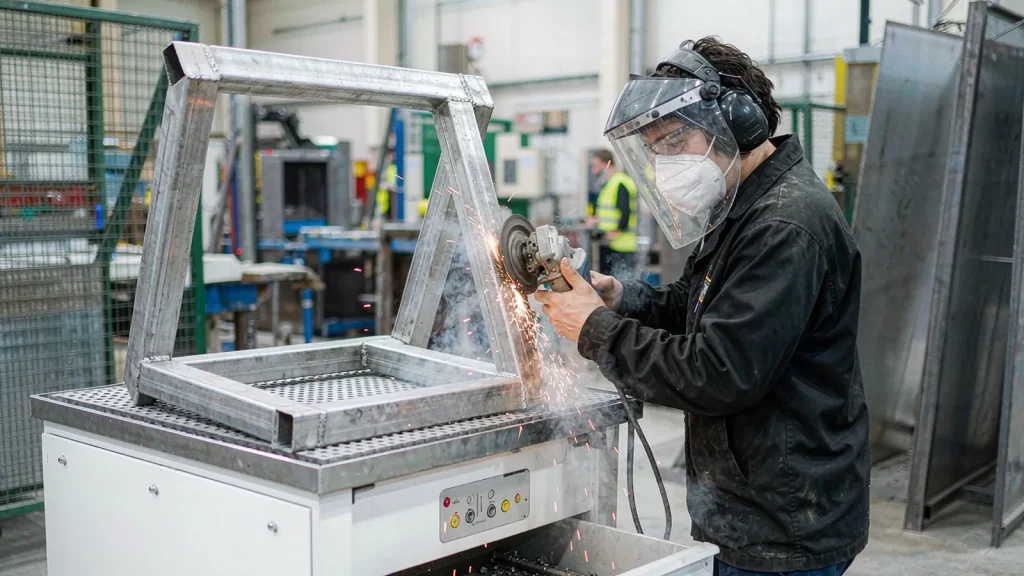
Grinding dust extraction is not a fume problem, it is a weight problem. A grinder throws material downward and outward at speed, in quantities measured in grams per minute rather than milligrams, and the dust it makes is heavy enough to fall straight out of the air if the capture point is in the wrong place.
45 mg/m³
exposure measured in a grinding area against a 4 mg/m³ respirable limit
19.8 mg/m³
highest mean total dust among 110 foundry workers — the fettling (grinding) jobs
1 in 3
personal samples over the exposure limit for crystalline silica in hand grinding of castings
Gravity does most of the work — if you let it
Welding fume rises and is measured in milligrams. Grinding dust falls, and is measured in grams. Two facts, and they lead to two completely different extraction designs.
A grinder spins an abrasive wheel at something like 80 metres per second and removes metal, casting skin, weld cap or paint along with it. Most of that material lands on the floor and the bench. The part that matters is the respirable fraction — the fine dust that never settles and goes straight to the deep lung — and the composition of it depends on what is being ground: metal from the workpiece, abrasive from the wheel, silica from castings and stone, and coatings from painted or galvanised parts.
This is why downdraft extraction is the standard answer for grinding and a poor answer for welding fume. Grinding dust is generated at the contact point, moving downward and outward, so air pulled down through a bench grille takes it away before it reaches the operator. The same principle fails on welding because welding fume rises. Get the direction of the dust wrong and the extraction is fighting gravity instead of using it.
What grinding dust measures like
45 mg/m³
Exposure measured in a foundry grinding area where the respirable limit is 4 mg/m³ and the inhalable limit is 10 mg/m³ for ferrous foundry particulate — an exposure more than ten times the respirable limit, in a bay that already had extraction.[1]
19.8 mg/m³
Highest mean total dust measured across 110 foundry workers, in the fettling — grinding — jobs, compared with lower values in almost every other foundry role.[2]
1 in 3 over
Roughly a third of personal samples exceeded the recommended exposure limit for crystalline silica in hand grinding of steel castings, with the largest wheels — the biggest grinders — identified as the main source.[3]
< 50% removed
In the same study, measurement of air recirculated from downdraft grinding benches showed that less than half of the respirable particles were being removed from the airstream — a reminder that downdraft capture is only half the job if the filtration class is not up to the fine fraction.[3]
Full sources are listed under References at the end of this page.
Pull it down and away, then filter it properly
A grinding table has two jobs: take the dust at the point of generation, and keep the operator clear of it. Both are decided by where the air is pulled from and how hard, not by the size of the filter box.
Downdraft at the work surface, at the right velocity
The units in this range are downdraft tables with the extraction grille built into the work surface. FDDM-18P (1,800 m³/h, 16 m² of media) covers a single bench, FDDM-36P (1,800–3,600 m³/h, 40 m²) and FDDM-50P (2,500–5,000 m³/h, 40 m²) cover wider benches and heavier operations, and FDDM-36H (3,200–3,600 m³/h, 28 m²) is the backdraft version for parts that cannot be worked flat on a grille. The airflow matters more than the box: too little and the dust rolls off the table edge toward the operator, too much and you pull the operator’s hands into the surface.
Match the cleaning and the media to the dust load
Grinding produces far more dust by weight than welding fume, so the cleaning system earns its keep. The rotary-wing reverse-pulse units — FDDM-18P, FDDM-36P and FDDM-50P — clean the cartridge without stopping the job. Where the work is intermittent, FDDM-15 (1,500 m³/h), FDDM-25 (1,800 m³/h) and FDDM-30 (3,000 m³/h, twin motor) are the manual-clean tables: nothing to go wrong, no compressed air, and a dust drawer that comes out for emptying. All of them filter to 0.3 µm, which is the specification that matters when a third of the dust you cannot see is the fraction that does the harm.
Downdraft tables for grinding and linishing
Seven downdraft and backdraft tables cover a single bench through to two-position finishing work, with manual or automatic cleaning. All of them filter to 0.3 µm.
What a grinding table installation includes
- A downdraft or backdraft table with the extraction grille or plenum built into the working surface, at the height you actually work at
- Cartridge sets matched to the dust — metal dust, casting skin and abrasive load differently — plus spare pre-filter media
- Dust drawer or bin arrangement for emptying, sized so a shift’s grinding does not need an interruption
- Commissioning with face velocity measured across the whole work surface, not at the centre only, so the corners do not become the places dust escapes
Send the part envelope, the wheel size and the material. A 230 mm grinder on a casting behaves differently from a linishing belt on sheet, and the difference shows up in the airflow and in how often the drawer needs emptying.
Finishing work this covers
Machine shops and metal finishing, foundry fettling and casting cleaning, weld dressing and cap grinding, linishing and polishing stainless sheet, and grinding of stone, composites and silicon materials. Materials covered include steel, stainless, aluminium, cast iron, and coated or painted work. Where the material is aluminium or magnesium in fine dust form, the risk changes from respiratory to explosive — the aluminium dust extraction page covers that case, because the collector has to be built differently.
At the bench
Questions from finishing shops
Send us the part size and the operation
Send us the part size, the operation (grinding, linishing, polishing, dressing), the material and the hours per shift. We will come back with the table arrangement, the airflow and whether manual or automatic cleaning fits the way the bench is actually used.
References
- Health and Safety Executive (UK). Respiratory protective equipment at work: a practical guide. HSG53 — worked example for a foundry grinding area, with respirable and inhalable limits for ferrous foundry particulate and measured exposures. hse.gov.uk
- Determination and prediction of respirable dust and crystalline-free silica in the Taiwanese foundry industry. Int J Environ Res Public Health 2018;15(10):2105. doi:10.3390/ijerph15102105 — reviewing measured dust levels by foundry job, including the fettling figure of 19.8 mg/m³.
- O’Brien D, Froehlich PA, Gressel MG, Hall RM, Clark NJ, Bost P, Fischbach T. Silica exposure in hand grinding steel castings. Am Ind Hyg Assoc J 1992;53(1):42–48. — personal samples against the NIOSH recommended exposure limit, and measurement of recirculated air from downdraft benches.
- Health and Safety Executive (UK). Controlling airborne contaminants at work: a guide to local exhaust ventilation. HSG258, 3rd ed. — Table 9 capture velocities for welding fume, and the commissioning checks for a moveable extraction arm. hse.gov.uk