
Wall Mounted Welding Fume Extraction
Wall mounted welding fume extraction is what you specify when the bay is too tight to put a mobile unit in front of the bench and too busy to duct a central system into. The footprint goes on the wall or the column, and the arm does the reaching.
0 m²
floor area taken by the extractor itself — it hangs off the wall or column
2,000–2,500 m³/h
extraction volume the wall-mounted units are built around
0.2 mg/m³
the UK manganese WEL — the enforceable number inside mild-steel welding fume
When the bay is smaller than the job
Some of the worst welding fume exposure happens in the tidiest workshops — the cell layout that puts four benches in a room built for two, with no floor space left for an extractor and no roof height worth ducting through.
A small bay concentrates everything. The welder is closer to the arc than he would be on an open floor. There is less volume of air to dilute the fume into, so the same arc produces a higher breathing-zone concentration. And the walls that make the bay efficient for production also stop the fume dispersing, which is why measured exposure in small shops often comes out worse than in large ones.
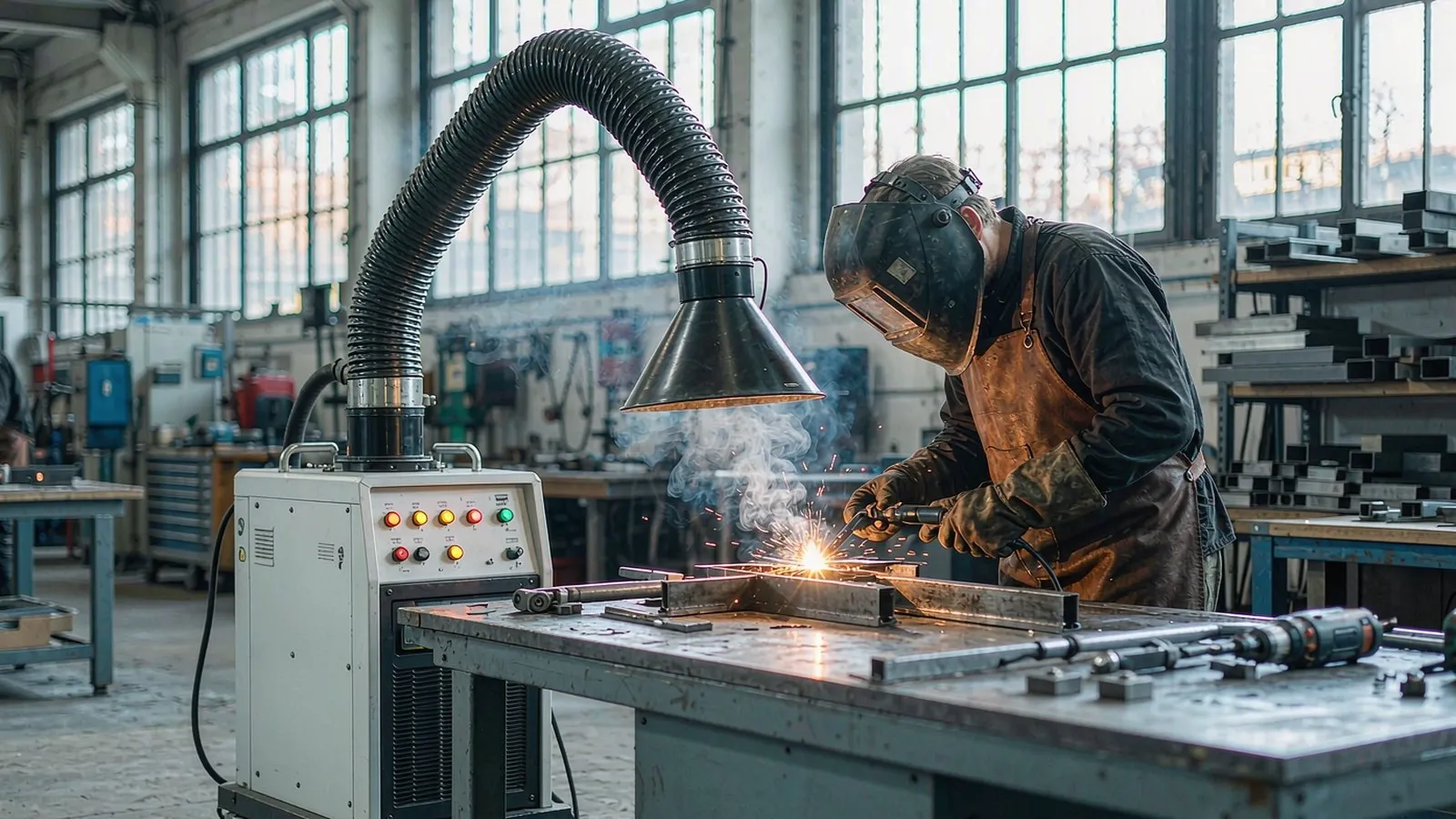
The practical answer is to take the extraction off the floor. A wall or column mounted unit puts the filter above head height and the arm where the welder can reach it, which is the only arrangement that survives when the bay is already full. It also keeps the bench clear for the job rather than for the extractor.
Why small bays are not low-risk bays
3.0–11.3 mg/m³
Breathing-zone total particulate measured within 0.5 m of manual metal arc welders across six factories — a reminder that concentration depends on the air around the arc, not only on the process.[1]
0.5–1.0 m/s
The capture velocity HSG258 expects at a welding arc. In a bay with cross-draught from a door or a machine fan, it is the top of that range that applies.[2]
0.2 mg/m³
The UK workplace exposure limit for manganese as Mn — the constituent limit that applies inside mild-steel welding fume. There is no single WEL for welding fume as a mixture, so the metals in it are what the control has to hold in the welder’s breathing zone.[3]
10.3–16.8 µg/m³
Manganese measured on bystanders standing near welding they were not doing — the number that matters when three benches share one small bay.[4]
Full sources are listed under References at the end of this page.
Put the unit where the floor is not, then aim the airflow
Two decisions settle a space-limited bay: where the filter body goes, and which direction the airflow runs across the bench. Get the first wrong and the extractor is in the way of the job; get the second wrong and it pulls fume through the welder instead of away from him.
Filter on the wall, arm at the bench
FDGQ-20P and FDGQ-20Z are the wall and column mounted units in this range, both built around 2,000–2,500 m³/h with a 23 m² cartridge, so a single unit can hold capture velocity at a bench that a 1,500 m³/h mobile unit would struggle with. They mount above head height and the 360° arm comes down to the work, which leaves the floor and the bench clear. The manual-clean FDGQ-20P suits intermittent work with no compressed air at the bay; FDGQ-20Z adds automatic cleaning where the bay runs every shift.
Lead the air away from the welder
In a tight bay the arm position matters more than the fan curve. The hood should sit between the arc and the wall, pulling the plume away from the operator and towards the unit, with the arm set so the welder can reposition it with one hand without leaving the joint. Where a door or a machine fan crosses the bay, the hood has to be positioned so the draught pushes fume towards the hood rather than across the operator — the same unit, mirrored, behaves like a different extractor.
The two wall and column mounted units
Two wall and column mounted units cover a single bench in a tight bay: one for intermittent work, one for a bay that runs every shift. Both filter to 0.3 µm and return clean air to the workshop.
What a wall mounted station includes
- Wall or column mounting brackets, sized for the unit at 2,000–2,500 m³/h, with the mounting height set from your bench and ceiling
- 360° self-supporting extraction arm with a hood that can be parked over the joint and repositioned with one hand
- Cartridge sets, and for FDGQ-20Z the compressed-air connection and cleaning control
- Commissioning with capture velocity measured at the arc with the bay door open and closed, so the worst case is the one on the report
Column mounting is preferred where the wall is a partition or a racking leg. Send a photo of the bay and the bench position and we will confirm which mounting will hold the unit and the arm load.
Bays this suits
Cellular manufacturing and production lines where each cell has one or two welding positions, mould and tool rooms, maintenance bays inside larger plants, small jobbing and repair shops, fabrication cells inside a larger hall, and any bay where a mobile unit would be pushed from pillar to pillar all shift. The units suit MMA, MIG/MAG and TIG work on small to medium fabrications. Where the bay is genuinely sealed and the part is large, a booth with downdraft or backdraft extraction is the better fit — see the grinding booth and grinding dust pages.
In the cell
Questions from cell and toolroom planners
Send us the bay drawing
Send us a plan of the bay with the bench and door positions, the processes used and how many hours a day the arc runs. We will come back with the mounting arrangement, the arm length and the cleaning mode, plus the capture-velocity figures we expect at the joint.
References
- Balkhyour MA, Goknil MK. Total fume and metal concentrations during welding in selected factories in Jeddah, Saudi Arabia. Int J Environ Res Public Health 2010;7(7):2978–2987. doi:10.3390/ijerph7072978 ncbi.nlm.nih.gov
- Health and Safety Executive (UK). Controlling airborne contaminants at work: a guide to local exhaust ventilation. HSG258, 3rd ed. — Table 9 capture velocities for welding fume, and the commissioning checks for a moveable extraction arm. hse.gov.uk
- Health and Safety Executive (UK). EH40/2005 Workplace exposure limits. hse.gov.uk
- Assenhöj M, Ervik T, Graff P, Karlsson H, Ljunggren SA. Impact of preventive measures on welding fume exposure among welders, robot operators, and bystanders. Int J Hyg Environ Health, vol. 276. stami.no
- IARC Working Group. Welding, molybdenum trioxide, and indium tin oxide. IARC Monographs on the Evaluation of Carcinogenic Risks to Humans, Volume 118, 2018. Summary: Guha N, et al. The Lancet Oncology 2017;18(5):581–582. doi:10.1016/S1470-2045(17)30255-3
- Health and Safety Executive (UK). Change in enforcement expectations for mild steel welding fume. Safety alert STSU1-2019. hse.gov.uk