
Welding Training Centre Fume Extraction
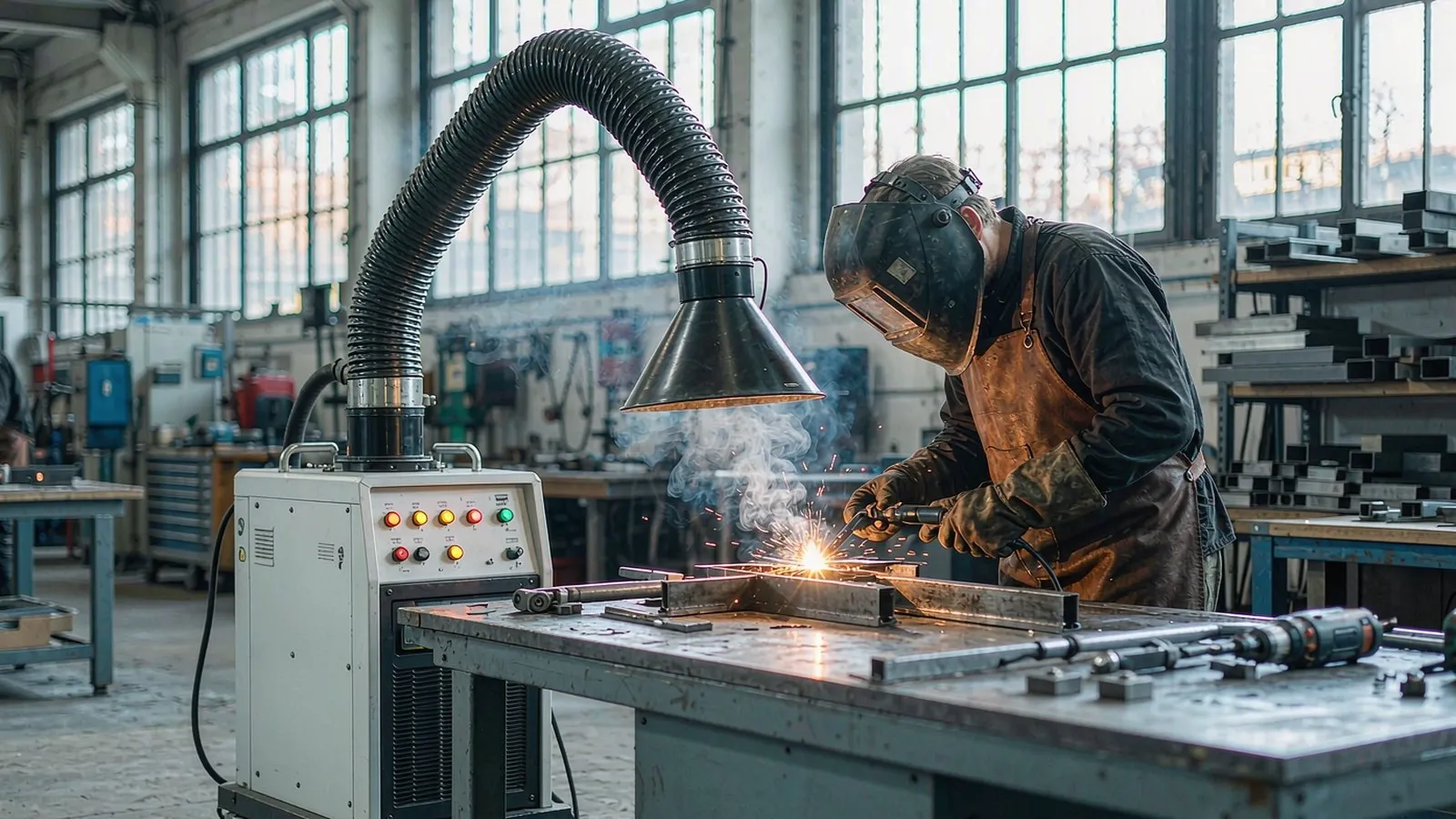
Welding training centre fume extraction has one problem a production shop does not: twenty arcs, twenty learners, and an instructor who walks between them all day. The extraction has to work for the person who is still learning where to hold the torch.
3.0–11.3 mg/m³
breathing-zone particulate measured within half a metre of the arc
10.3–16.8 µg/m³
manganese measured on bystanders — the instructor walking the line
0.5–1.0 m/s
capture velocity HSG258 expects, and a learner repositions the hood constantly
Twenty arcs, one instructor
In a training bay the fume does not come from one torch. It comes from twenty, at different heights, in different positions, on work that is being welded for the first time.
A learner holds the torch closer to the joint than a tradesman, works in positions a production welder would avoid, and takes longer over each run — which means the arc is on for more of the minute, not less. The hood gets knocked, repositioned badly, or not repositioned at all, because the person using it has something else to concentrate on. And the instructor moves down the line, standing in the fume of booths he is not teaching in.
That combination — many sources, poor hood discipline, someone walking between them — is why training bays need their own answer rather than a copy of a production installation. The extraction has to be positioned so it works even when it is not adjusted, and it has to protect the person in the aisle as well as the person at the bench.
What shared bays measure like
3.0–11.3 mg/m³
Breathing-zone total particulate measured within 0.5 m of manual arc welders over full 8-hour shifts in six factories — the range a booth is designed to keep the learner out of.[1]
10.3–16.8 µg/m³
Median manganese on bystanders who were not welding, only standing near it. The instructor in the aisle is a bystander.[2]
4–8×
The recommended nanoparticle exposure limit was exceeded by four to eight times in every welding operation measured, manual and automatic — the reason a booth needs real airflow, not a fan and a filter.[3]
0.5–1.0 m/s
The capture velocity HSG258 expects at a welding arc. On a booth where the hood is repositioned by a learner, commissioning has to be done at the worst realistic hood position, not the best.[4]
Full sources are listed under References at the end of this page.
One hood per booth, aimed by the learner
The design rule for a training bay is one extraction point per booth, sized so that it holds capture velocity at the hood position a learner actually uses, and positioned so that the aisle stays outside the fume path rather than inside it.
A hood each, not one big fan for the room
General ventilation is the wrong tool here: it dilutes fume after it has passed the learner’s breathing zone, and HSG258 expects extraction at the arc instead. So each booth gets its own hood. FDGQ-20P and FDGQ-20Z wall mounted units suit booths along a wall or a column, at 2,000–2,500 m³/h with a 23 m² cartridge, and leave the floor clear — which matters when thirty students and their kit are moving around. Where booths are free-standing, FDYD-12P, FDYD-15P and FDYD-20P2 are the mobile units, with FDYD-20P2 carrying two independent 360° arms on one filter to serve two adjacent booths.
Choose the cleaning mode by timetable, not by taste
A training workshop is rarely a continuous production line: it runs flat out for a module and then sits idle. That intermittent pattern suits manual-clean units, which cost less, have nothing to go wrong and need no compressed air. Where the bay runs back-to-back classes all week, automatic pulse-jet cleaning is the right answer — FDGQ-20Z at a booth, and FDYD-22H or FDYD-38H2 on castors where the layout changes between courses.
Units for training bays
Seven units cover a training bay of two booths or twenty, on the wall or on castors. All of them filter to 0.3 µm and return clean air to the workshop, so nothing has to be ducted out through a wall.
What a training bay installation includes
- A hood and arm per booth, sized so the hood can be parked and left rather than held, and positioned so the aisle is not in the fume path
- Wall or column mounting brackets for booth rows, with the mounting height set from the bench and the ceiling
- Cartridge sets, spare arms and hoods — training bays damage hoods, and a spare keeps the booth in service
- Commissioning at the worst realistic hood position, with readings recorded per booth, plus a one-page operating note for the booth wall
Send the bay layout with bench positions and door and window openings. Cross-draught down a row of booths is the single most common reason a training installation under-performs.
Courses and bays this covers
Colleges and vocational schools, welding academies and apprenticeship schemes, in-house training centres in fabrication and engineering companies, and assessment centres running coded welder tests. Courses covered include MMA (stick), MIG/MAG, TIG and flux-cored at all positions. Where the bay is also used for cutting and grinding practice, the fume and dust sources change — the grinding dust and plasma cutting pages cover those separately rather than pretending one unit handles both.
In the training bay
Questions from colleges and training managers
Send us the bay plan and the student numbers
Send us the bay plan, the booth count, the processes taught and the timetable. We will come back with an arrangement per booth, the mounting or mobile choice, and the commissioning figures we expect at the position a learner actually leaves the hood in.
References
- Balkhyour MA, Goknil MK. Total fume and metal concentrations during welding in selected factories in Jeddah, Saudi Arabia. Int J Environ Res Public Health 2010;7(7):2978–2987. doi:10.3390/ijerph7072978 ncbi.nlm.nih.gov
- Assenhöj M, Ervik T, Graff P, Karlsson H, Ljunggren SA. Impact of preventive measures on welding fume exposure among welders, robot operators, and bystanders. Int J Hyg Environ Health, vol. 276. stami.no
- Occupational exposure to nanoparticles originating from welding — case studies from the Czech Republic. Med Pr 2021;72(3):219–230. PMID 33835113. pubmed.ncbi.nlm.nih.gov
- Health and Safety Executive (UK). Controlling airborne contaminants at work: a guide to local exhaust ventilation. HSG258, 3rd ed. — Table 9 capture velocities for welding fume, and the commissioning checks for a moveable extraction arm. hse.gov.uk