
Soldering Fume Extraction
Soldering fume extraction deals with the smallest fume in the building: a bench with no visible plume, no measurable dust on the bench, and a flux aerosol that is one of the better documented causes of occupational asthma in electronics work.
× 2.6
odds of wheeze among solderers compared with unexposed workers
> 90% vs 38–58%
capture efficiency with and without the push airflow, 420 mm from the hood
0.05 mg/m³
the UK 8-hour limit for rosin-based solder flux fume, as total resin acids
A bench with nothing to see
Soldering does not announce itself. There is no plume you can see over the bench, no soot on the extraction hood, and the person doing it usually has no symptoms until they have them.
What is being generated is a flux aerosol. Rosin, also called colophony, is a pine resin and the most common flux base in electronics; heated at the tip it produces a fine aerosol with resin acids in it, and repeated exposure to it is associated with respiratory sensitisation and asthma. Lead solder adds metal vapour, and lead-free work runs hotter, which increases the flux breakdown products rather than removing the hazard.
The exposure depends far more on where the extraction sits than on how big it is. In bench work the source is a few centimetres wide and the breathing zone is 300 mm above it, so capture at 100–200 mm from the joint does the job a large unit further away cannot. This is measured rather than asserted: in the solder fume trials, removing the push airflow dropped capture efficiency from over 90% to between 38% and 58% at only 420 mm from the hood, with the same exhaust airflow.
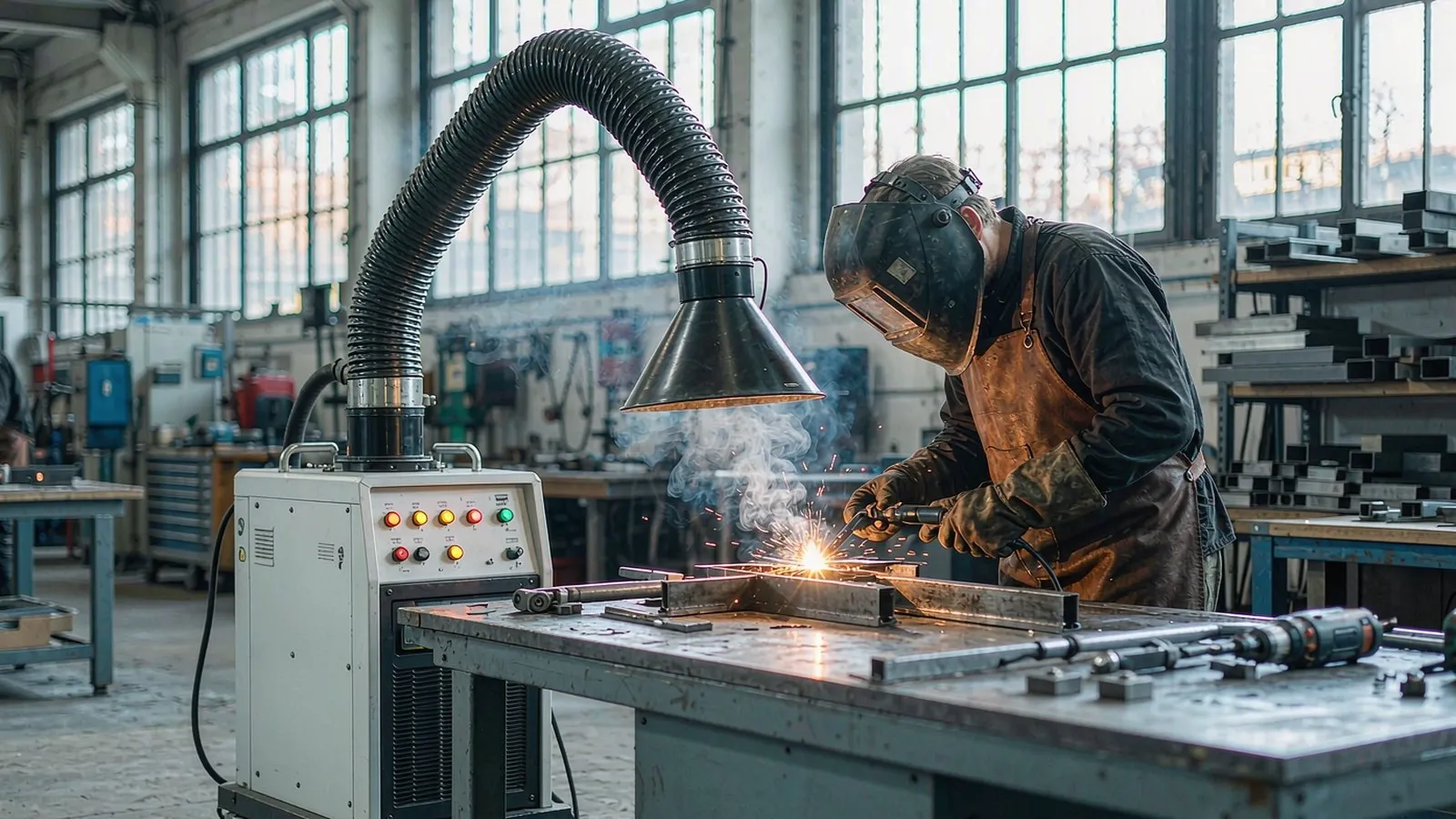
What the solder fume studies show
× 2.6
Meta-analysis of seven studies: soldering was associated with a 2.6-fold increase in the odds of wheeze after controlling for smoking, with small but significant reductions in FEV₁ and FVC across the groups studied.[1]
> 90% vs 38–58%
Capture efficiency of a bench extraction system with the push airflow running, against the same exhaust airflow without it, at 420 mm from the hood face. Distance is the variable that matters most.[2]
3–4× over limit
In five electronics factories, personal exposure with the existing shop ventilation ran three to four times the limit; with close capture it was brought below the UK 8-hour limit of 0.05 mg/m³ in most instances.[2]
Almost half
Share of PCB solderers reporting eye, nose or throat irritation in an electronics workforce study — symptoms that improved away from work, which is the classic pattern of a work-related exposure.[3]
Full sources are listed under References at the end of this page.
Close capture at the bench, and keep the tip clean
A soldering bench is the easiest place in a factory to control an airborne hazard, because the source is fixed, small and close to the operator. The whole design problem is getting the capture point to within about 150 mm of the joint without obstructing the work.
Capture at the joint, not at the room
FDQW-8G is the bench unit for this duty: 0–1,300 m³/h with a controllable speed, five-stage graded filtration ending in an odour stage, a filter-clog alarm and a long-range remote so the unit can be switched and adjusted without reaching under the bench. For bench work the airflow is turned down, not up — a high-flow unit pulling from the wrong position drags the flux aerosol across the operator’s face instead of away from it, which is exactly what the measured capture figures show when the air path is wrong.
Handle the two things that make soldiers stop using it
The first is noise — a bench extractor that is audible over the bench does not get switched on. The second is the tip position: a hood that has to be moved out of the way for every joint does not get repositioned. So the extraction arm and hood are arranged so the soldering iron can come and go under the hood without the operator touching anything, and the unit runs at the lowest airflow that still holds capture at the joint. Where several benches share one bench layout, the ducting can run to a single unit, but each bench keeps its own hood position.
Units for soldering and electronics benches
One unit covers us to four soldering benches on a common duct, from 0 to 1,300 m³/h with graded filtration and an odour stage.
What a soldering bench installation includes
- A bench hood positioned so the iron can be brought under it without moving the hood, at the airflow your bench actually needs
- Five-stage graded filtration with a final odour stage — the flux aerosol produces both a fine particle fraction and an organic one
- Bench-to-unit ducting where the unit sits under or beside the bench, or a shared duct run where one unit serves several benches
- Commissioning with airflow set per bench position, and the readings recorded so a later re-check compares like with like
Tell us the flux type — rosin, no-clean, water-soluble — and whether lead-free solder is used. The flux chemistry changes what the odour stage has to take out.
Bench work this covers
PCB assembly and hand soldering, cable and harness assembly, electronics repair and rework benches, medical device and instrument assembly, R&D and laboratory benches, and training workshops teaching electronics. Processes include hand soldering, rework and touch-up, de-soldering, adhesive curing on hot benches and small-scale laser marking of populated boards. Where the bench also does laser cutting or engraving of plastics, the plume is larger and the ventilation demand higher — the laser cutting page covers that case.
At the bench
Questions from electronics production
Send us the bench count and the flux type
Send us the number of benches, the flux type, whether solder is lead-free, and how the benches are laid out. We will come back with the hood arrangement, the airflow per bench and whether a shared unit or individual units fit the room.
References
- Mendy A, Gasana J, Forno E, Vieira ER, Dowdye C. Work-related respiratory symptoms and lung function among solderers in the electronics industry: a meta-analysis. Environ Health Prev Med 2012. pmc.ncbi.nlm.nih.gov
- Watson SI, Cain JR, Cowie H, Cherrie JW. Development of a push-pull ventilation system to control solder fume. Ann Occup Hyg 2001;45(8):669–676. doi:10.1093/annhyg/45.8.669
- Greaves IA, Wegman DH, Smith TJ, Spiegelman DL. Respiratory effects of two types of solder flux used in the electronics industry. J Occup Med 1984;26(2):81–85. PMID 6707774. pubmed.ncbi.nlm.nih.gov
- Health and Safety Executive (UK). Lung disease A–Z — occupational asthma, including rosin (colophony) solder flux fume as a recognised cause. hse.gov.uk
- Health and Safety Executive (UK). Controlling airborne contaminants at work: a guide to local exhaust ventilation. HSG258, 3rd ed. — Table 9 capture velocities for welding fume, and the commissioning checks for a moveable extraction arm. hse.gov.uk