
High Vacuum Fume Extraction and On-Torch
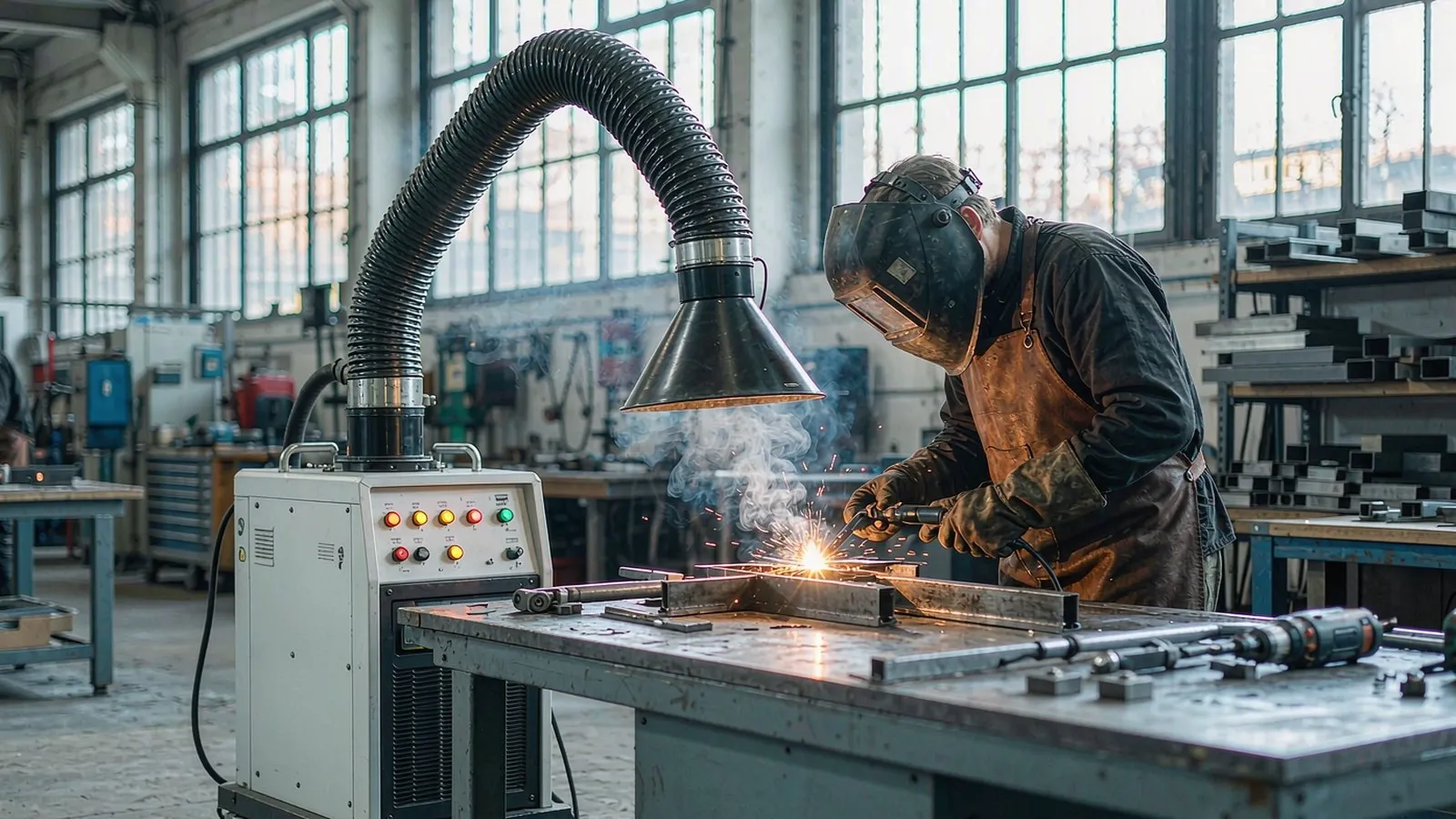
High vacuum fume extraction puts the capture opening at the arc instead of beside it. Where a hood cannot be brought to the joint — inside a tank, on a scaffold, along a weld seam in a confined space — on-torch extraction is the only method that travels with the source.
90–95%
capture rate reported for on-torch extraction when the gun is used properly
210–420 m³/h
air volume of the high-vacuum units, against 800+ m³/h for an extraction arm
4.73–5.90 mg/m³
breathing zone in an enclosed space, against 2.89–4.38 in the open
Where the air cannot get away, the fume stays
In an open bay the fume rises and disperses. Inside a tank, a hold, a duct run or a vessel, it does neither — it collects, and it stays where the welder is working.
Confined-space welding is the case where extraction has to travel with the person rather than stand in one place. A hood on an arm is useless when the welder is inside a vessel with the torch overhead, and blow-suction or hall ventilation cannot reach into an enclosed volume at all. The measured difference is stark: the same welder doing the same job averaged a breathing-zone total particulate of 2.89–4.38 mg/m³ in an open breezeway but 4.73–5.90 mg/m³ inside a boiler room.
The on-torch answer integrates the capture nozzle with the welding gun, connected by a hose to a high-vacuum unit. Because the opening sits 25–50 mm from the arc, it captures fume as it is formed, before it can rise and before the welder can breathe it — and because it travels with the gun, nobody has to reposition it. That is its strength and its limitation in one sentence: it only captures what the torch is producing while the arc is on.
What the confined-space numbers show
4.73–5.90 mg/m³
Breathing-zone total particulate for the same welder doing the same shielded metal arc welding inside a boiler room, against 2.89–4.38 mg/m³ in an open breezeway — and the arc was struck for only 20–25% of the sampling time.[1]
90–95%
Capture rate reported for on-torch extraction when the gun is held correctly, capturing at the arc. The same source notes that the location matters: on-torch extraction does not work well inverted, because fume rises.[2]
≈60 vs 600–1,200
Airflow of an on-torch nozzle against a fume arm, in the same units. On-torch extraction captures with high vacuum and a small opening rather than with volume — which is why it needs a high-vacuum unit rather than any collector.[3]
25–50 mm
Working distance of the capture opening from the arc on on-torch extraction, against 150–300 mm for a fume arm — and capture velocity falls away sharply with distance, which is the whole argument for putting the opening at the source.[4]
Full sources are listed under References at the end of this page.
Extract at the arc, with a hose that travels
On-torch extraction is a system of three parts: the gun or the nozzle fitted to it, the hose that carries the fume without adding weight at the welder’s hand, and the high-vacuum unit that provides the suction. Each of the three can make the other two useless, so they are specified together.
High vacuum, small opening, at the arc
FDYC-2G at 210 m³/h and FDYC-4G at 210–420 m³/h are the high-vacuum units for on-torch duty, with 11 m² of media and automatic pulse-jet cleaning. The airflow is deliberately small — it is doing the work of a vacuum nozzle rather than of a hood — and the unit is on castors so the weld itself can be anywhere the hose will reach. For site work the unit stays outside the confined space and the hose carries the fume out, which is also the safer arrangement where the atmosphere inside has to be monitored.
Accept what it does not capture
On-torch extraction covers MIG/MAG well; it is not the whole answer for other processes or for positions where the nozzle is inverted. It also misses the smoke that keeps coming off the seam after the trigger is released, which is significant on coated or oily material — so an on-torch installation in a confined space is normally specified with ventilation of the space as well, and with the atmosphere monitored. Used as one part of a control package it is the most effective capture available; relied on alone in a tank it is not.
High-vacuum units for on-torch extraction
Two high-vacuum units cover on-torch extraction, from a single gun to two guns on one unit. Both filter to 0.3 µm and both run automatic cleaning.
What an on-torch installation includes
- High-vacuum unit sized for the gun or guns in use, on castors, with the suction hose specified to keep the weight at the welder’s hand workable
- On-torch nozzle or fume gun matched to the welding process and the torch in use, plus spare consumable parts for the nozzle
- Hose lengths and couplings chosen so the unit can stay outside a confined space, with the hose route fixed rather than dragged
- Commissioning with the suction checked at the nozzle with the gun in the working position, plus a note on what the system does and does not capture
Tell us the process, the torch, the position, the access route and whether the space is confined. Whether one unit can serve two guns depends more on hose runs and access than on airflow.
Work this suits
Confined-space welding in tanks, vessels, silos and ducts; shipbuilding and ship repair; pipework and pressure vessel work in restricted positions; structural welding on site where the work is above head height or against an obstruction; narrow workstations where an arm cannot be fitted; and mobile on-site welding where there is no fixed extraction at all. Processes covered: MIG/MAG primarily, with on-torch fume guns being a MIG/MAG device; for MMA, TIG and flux-cored work in confined spaces the units can still be used with a nozzle arrangement, but the capture characteristics differ and the exposure assessment matters more.
On the job
Questions from site welding teams
Send us the job and the access
Send us the process, the torch, the position, the access route and whether the space is confined. We will come back with the unit, the nozzle arrangement and the hose route — and say plainly where on-torch extraction will not be enough on its own.
References
- Boelter FW, Simmons CE, Berman L, Scheff P. Two-zone model application to breathing zone and area welding fume concentration data. J Occup Environ Hyg 2009. doi:10.1080/15459620902809895 pubmed.ncbi.nlm.nih.gov — one welder, SMAW on carbon steel, breezeway versus boiler room.
- Frequently asked questions: fume guns — capture rate, airflow and the positions in which on-torch extraction stops being effective. Manufacturer technical guide. robovent.com
- Source capture systems for weld fumes — fume gun versus fume arm airflow, capture rate and the one-duct-diameter positioning rule. Manufacturer technical guide. robovent.com
- Health and Safety Executive (UK). Controlling airborne contaminants at work: a guide to local exhaust ventilation. HSG258, 3rd ed. — Table 9 capture velocities for welding fume, and the commissioning checks for a moveable extraction arm. hse.gov.uk
- IARC Working Group. Welding, molybdenum trioxide, and indium tin oxide. IARC Monographs on the Evaluation of Carcinogenic Risks to Humans, Volume 118, 2018. Summary: Guha N, et al. The Lancet Oncology 2017;18(5):581–582. doi:10.1016/S1470-2045(17)30255-3
- Health and Safety Executive (UK). Change in enforcement expectations for mild steel welding fume. Safety alert STSU1-2019. hse.gov.uk